
Programmable Settlements in Cross-Border Trade: Connecting Payments to Commercial Milestones
Cross-border trade involves more than moving money between countries. Explore how programmable settlement orchestration can connect payment allocation and release to agreed commercial milestones, giving banks and businesses a more controlled way to coordinate trade transactions.
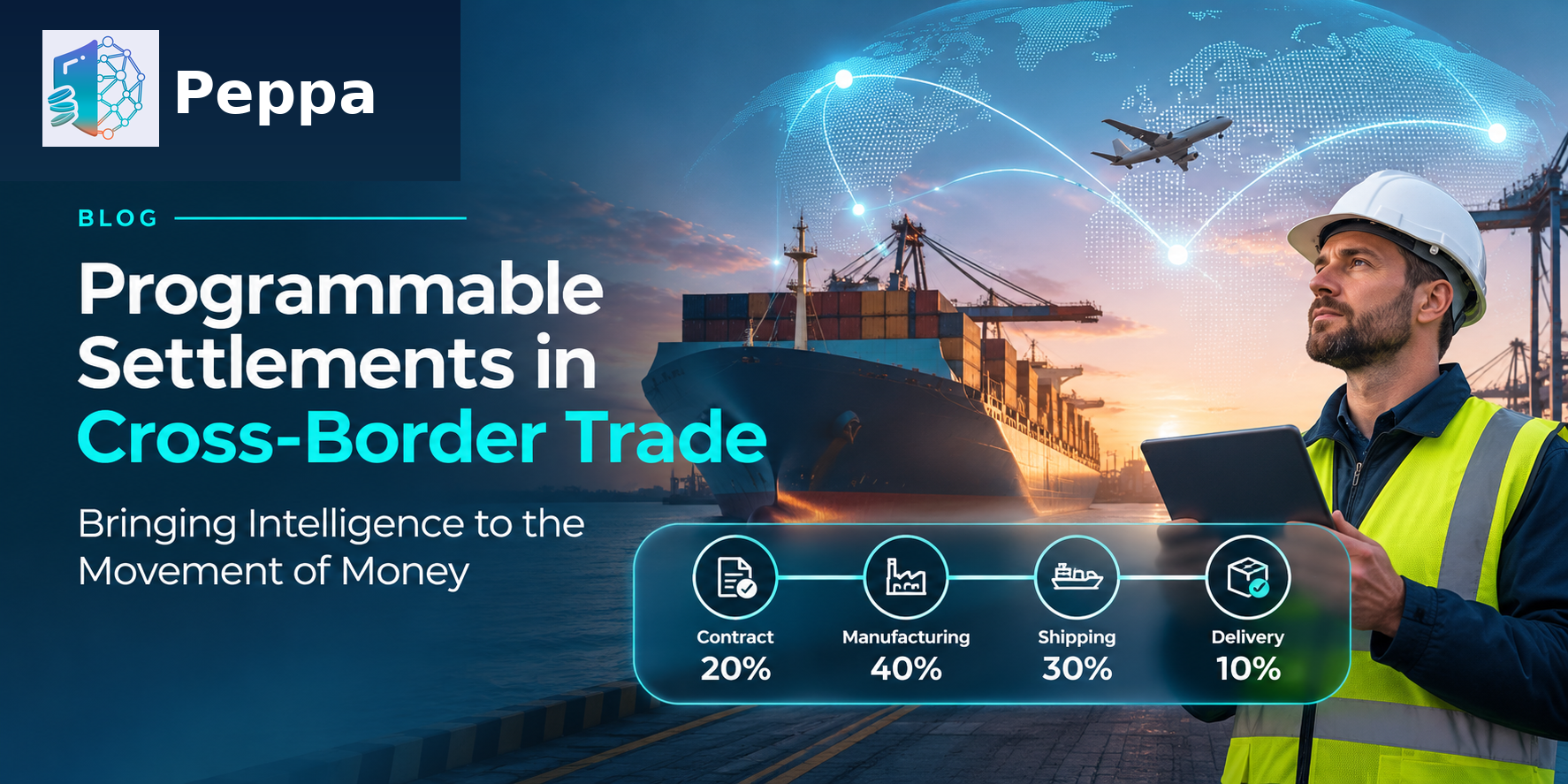
Programmable Settlements in Cross-Border Trade: Connecting Payments to Commercial Milestones
Moving money across borders is only one part of completing an international trade transaction.
An importer and an exporter must also coordinate contractual obligations, payment timing, documentation, shipment and acceptance. Banks and other financial institutions support parts of that process, often through systems and workflows that operate independently.
That creates a practical challenge: the payment process may not have a shared, structured view of the commercial conditions that should govern when funds are allocated or released.
Programmable settlement orchestration offers a way to connect agreed payment rules to defined transaction events. For banks, importers and exporters, this creates an opportunity to structure settlement around the commercial milestones of a trade transaction.
The coordination challenge in cross-border trade
Consider a Nigerian importer purchasing $500,000 of industrial equipment from a supplier in Asia.
The parties agree to pay in stages:
- 20% when the contract is executed.
- 40% when manufacturing is completed.
- 30% when specified shipping documents are accepted.
- 10% after delivery and acceptance.
Each instalment reflects a different point in the commercial relationship. The importer wants payment to follow the agreed conditions. The exporter needs confidence that payment will be made as obligations are fulfilled. The financing bank needs to apply its own authorisation, compliance and transaction controls.
The process can involve several separate activities: initiating payments, confirming milestones, reviewing documents, communicating with counterparties and reconciling what has been paid against what remains due.
The difficulty is not necessarily the ability to transfer funds internationally. It is coordinating payment instructions with the events and evidence that determine whether a payment should proceed.
What changes when settlement is programmable?
A programmable settlement arrangement makes the agreed payment logic explicit.
The parties or the relevant financial institution can define:
- Who is involved: the payer, beneficiaries and authorised participants.
- How funds are allocated: fixed amounts, percentages or remaining balances, as permitted by the settlement arrangement.
- What conditions apply: the milestones or authorised confirmations associated with each release.
- Who can confirm an event: the party or system authorised to submit or approve the relevant evidence.
- What happens when something changes: the process for rejected evidence, disputes, amendments or manual review.
- What is recorded: the rules applied, the events received, the decisions made and the resulting payment instructions.
The settlement layer evaluates the configured rules and coordinates the corresponding instruction with the underlying payment provider or financial institution.
This distinction matters. Programmability does not require every participant to adopt a new payment rail. It can operate as an orchestration capability alongside existing payment infrastructure, subject to the capabilities and permissions of the institutions involved.
Use case: A milestone-based settlement for a $500,000 import
The following example illustrates how a structured settlement arrangement could work. It is a hypothetical model, not a report of a completed Peppa customer transaction.
1. Contract execution and initial payment
The importer and exporter agree the contract value, beneficiaries, payment schedule and conditions.
The settlement rules specify an initial payment of $100,000, representing 20% of the contract value, following the required contract and payment authorisations.
The remaining amount is allocated to subsequent milestones under the agreed rules.
2. Manufacturing completion
When manufacturing is reported as complete, the supplier submits the required confirmation or supporting evidence.
An authorised party reviews the evidence according to the agreed process. If the milestone is approved, the settlement arrangement can trigger the instruction for the next $200,000 instalment.
The important control is the link between the milestone decision and the payment instruction. The platform should not independently assume that a supplier's submission proves completion.
3. Shipping documentation
The supplier submits the specified shipping documents. The designated reviewer checks them against the contractual requirements.
Once the required approval is recorded, the next $150,000 payment instruction can be initiated.
The document review remains the responsibility of the authorised institution or party. Programmable settlement orchestration coordinates the resulting decision; it does not itself make a document legally compliant or guarantee the accuracy of its contents.
4. Delivery and acceptance
After delivery, the importer or its authorised representative confirms acceptance in accordance with the contract.
That confirmation satisfies the final milestone condition, allowing the remaining $50,000 payment instruction to proceed.
| Trade milestone | Payment amount | Illustrative condition |
|---|---|---|
| Contract execution | $100,000 (20%) | Contract and payment authorisations |
| Manufacturing completion | $200,000 (40%) | Completion confirmation approved |
| Shipping documentation | $150,000 (30%) | Required documents accepted |
| Delivery and acceptance | $50,000 (10%) | Buyer acceptance recorded |
| Total | $500,000 (100%) |
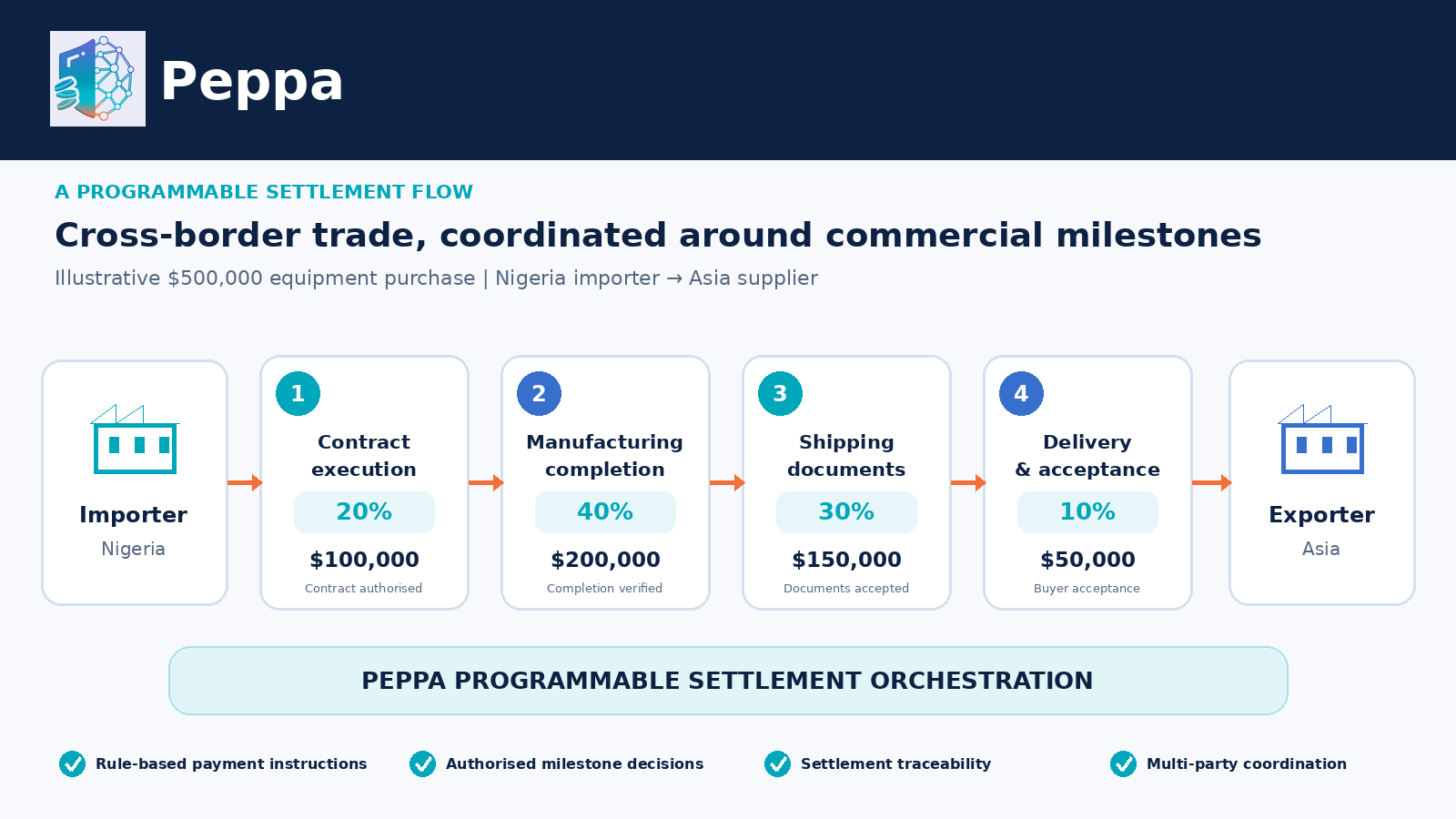
The value is not simply that the contract is divided into instalments. It is that the settlement rules, milestone decisions and payment instructions can be coordinated through a defined process, with a record of the decisions made along the way.
Why this matters to banks and financial institutions
For banks, programmable settlement orchestration creates an opportunity to offer corporate customers more configurable payment arrangements.
More flexible transaction banking propositions
A bank can explore settlement structures that reflect the commercial terms of a customer's trade relationships. These may include milestone-based releases, conditional disbursements and allocations across multiple beneficiaries.
That flexibility can support differentiated corporate banking services, particularly where customers have complex supplier or buyer relationships.
A clearer control framework
Payment instructions can be associated with defined rules, approval requirements and authorised events. This gives the institution a structured way to coordinate the conditions that must be satisfied before an instruction proceeds.
The bank's existing compliance, risk and payment controls remain essential. Programmable rules should operate within those controls, not bypass them.
Better traceability across settlement decisions
A structured record of configured rules, submitted events, approvals and payment instructions can help participating teams understand how a settlement decision was reached.
This can support operational review and reconciliation. It does not remove the need to reconcile against the authoritative records held by the relevant payment providers and financial institutions.
New value-added services
Banks can consider packaging configurable settlement capabilities as part of their broader transaction banking proposition. Potential services include conditional supplier payments, milestone-based disbursements and multi-party allocation arrangements.
The commercial opportunity will depend on customer demand, regulatory permissions, integration requirements and the economics of delivering the service.
Programmable settlement complements trade finance
Programmable settlement orchestration should be understood in the context of existing trade finance infrastructure.
Letters of credit, documentary collections, guarantees and other trade finance instruments address specific contractual, documentary and counterparty risks. A programmable settlement layer does not automatically replace these instruments or provide the protections associated with them.
Its role is narrower: to coordinate settlement rules and payment instructions around defined conditions and authorised decisions.
Nor does conditional payment logic eliminate the risks of international trade. Counterparty failure, inaccurate documents, shipment problems, fraud, sanctions exposure, foreign exchange movements and regulatory requirements still need to be managed.
The underlying contract, verification process, institutional controls and payment execution arrangements remain critical.
The infrastructure opportunity: connecting commercial events to financial execution
The broader opportunity is to make settlement arrangements more configurable and easier to coordinate.
A bank or payment provider can define reusable settlement policies rather than treating every multi-stage transaction as a collection of unrelated instructions. Those policies can specify allocations, conditions, authorised confirmations and the actions to take when a milestone is approved or rejected.
An orchestration layer can then evaluate incoming events against the configured policy and coordinate the appropriate instruction with the underlying financial infrastructure.
This is particularly relevant where several parties participate in a transaction and payment obligations change as the trade progresses.
The orchestration layer does not need to replace the bank's core systems or the payment networks used to move funds. It needs to connect the commercial rules to the institution's authorised financial execution processes.
Where Peppa fits
Peppa is developing programmable settlement orchestration to help financial institutions and businesses translate commercial settlement rules into structured, executable payment workflows.
The platform's role is to provide a configurable decision and orchestration layer around settlement logic. Depending on the supported payment infrastructure and implementation, this can include defining allocations, evaluating conditional or milestone-based release rules, coordinating event-driven decisions and maintaining an auditable record.
For cross-border trade, the use-case opportunity includes:
- Structuring milestone-based supplier payment arrangements.
- Defining fixed, percentage-based or remaining-balance allocations.
- Coordinating settlement decisions with authorised milestone confirmations.
- Managing exceptions and approval requirements within a defined policy.
- Connecting settlement orchestration to existing payment infrastructure.
The specific payment routes, currencies, document-verification responsibilities and regulatory arrangements must be established with the participating institutions. Advanced foreign exchange execution and production-scale cross-border optimisation should not be assumed as inherent capabilities of the orchestration layer.
The objective is to give banks greater flexibility in how they design and deliver settlement services, while allowing them to retain control of the underlying financial infrastructure and regulated activities.
Moving from payment processing to settlement orchestration
International trade will continue to depend on trusted counterparties, financial institutions and reliable payment networks.
There is, however, an opportunity to improve how the financial obligations within a trade transaction are coordinated.
Programmable settlements make it possible to express payment arrangements as rules, connect those rules to authorised commercial events and coordinate the resulting payment instructions through existing financial infrastructure.
For banks, this opens a path towards more configurable transaction banking services. For importers and exporters, it offers a more structured way to align payment arrangements with the milestones agreed in their commercial contracts.
The strategic question for financial institutions is how to make settlement respond more intelligently to the commercial conditions governing a transaction.
Moving money across borders remains essential. Coordinating when, how and under what authorised conditions it moves is where programmable settlement orchestration can add value.