
The Programmable Corporate Account: Turning Bank Accounts into Business Infrastructure
Corporate bank accounts could do more than receive and send money. Discover how programmable settlement rules can help banks build more intelligent transaction banking services.
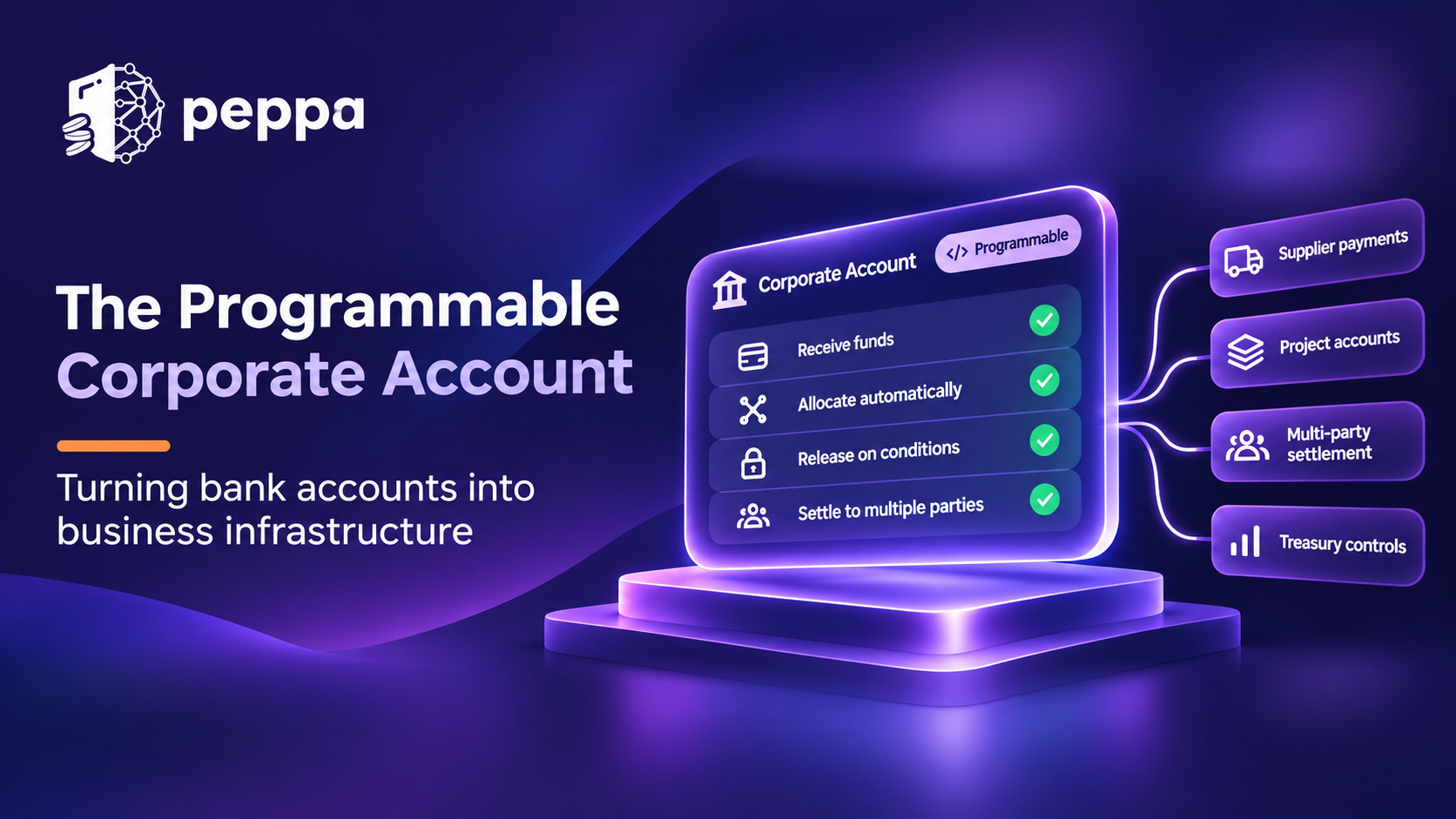
The Programmable Corporate Account: Turning Bank Accounts into Business Infrastructure
A corporate bank account has traditionally had a fairly straightforward job. It receives money, holds balances and allows an authorised person to make payments.
For many businesses, that is no longer enough.
A company receiving payments from hundreds of customers may need to allocate each receipt to a specific project, reserve part of it for tax, pay suppliers when agreed conditions are met and maintain a clear record of every movement. A business managing several subsidiaries may need funds to be visible by entity, project or business unit while retaining central oversight. A bank supporting a large importer may need to coordinate payments with contract milestones, approvals and documentary events.
These are business processes with financial consequences. Yet the account and the process governing what happens to its money are often treated as separate things.
There is an opportunity for banks to bring them closer together.
From account access to account behaviour
Corporate banking has made significant progress in digital access, payment initiation, reporting and cash visibility. APIs, virtual accounts and improved payment infrastructure have given businesses more ways to interact with their banks.
The next opportunity is to make those services more responsive to the rules of the customer's business.
Imagine a corporate account that can be configured around questions such as:
- When money arrives, how should it be identified and allocated?
- Which portion should remain available for working capital?
- Which suppliers or partners are entitled to receive payment?
- What approval or business event must happen before a payment is released?
- What should happen when an instruction is incomplete, a payment fails or a transaction changes?
- What record should be available to the finance team afterwards?
A programmable corporate banking proposition makes these rules part of the service design. The bank can offer customers a way to define how money should behave within agreed permissions and controls.
The account becomes an entry point to a wider financial workflow.
Consider a business receiving money from several directions
Take an illustrative building materials distributor supplying contractors across several projects.
Customers pay deposits and balances into the distributor's banking arrangements. Each order creates obligations to suppliers, delivery partners and the distributor itself. Some payments are due immediately. Others depend on delivery, acceptance or an agreed approval.
The finance team needs to keep track of incoming receipts, identify the relevant orders, calculate what is owed and ensure that payments are made at the right time.
A conventional account can receive the money and support payment initiation. Virtual accounts may help identify receipts by customer, project or invoice. But the wider settlement process still needs rules: how much is allocated, which beneficiary receives it, what conditions apply and who is authorised to approve the instruction.
A programmable arrangement could coordinate that sequence.
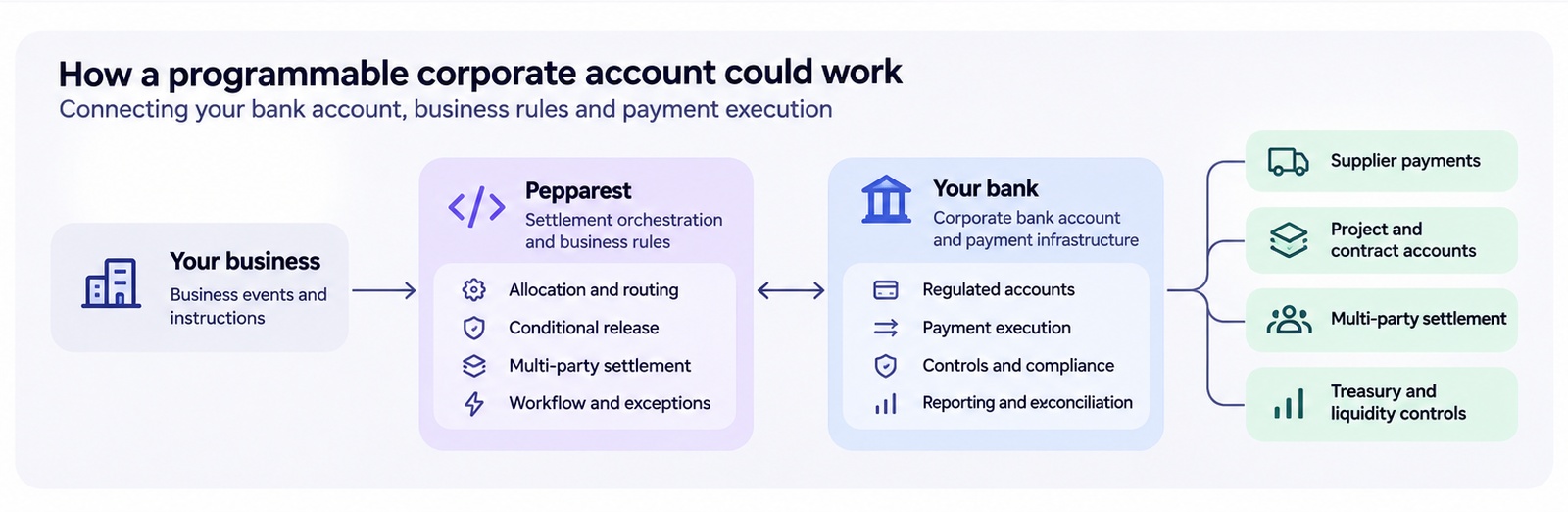
What could a programmable account enable?
The opportunity extends across several corporate banking use cases. The precise functionality would depend on the bank's account architecture, payment capabilities, integrations and regulatory arrangements.
1. Automatic allocation of incoming funds
A business could define allocation policies for incoming receipts. A payment associated with a particular project or invoice could be assigned to the relevant balance or accounting category, with configured amounts reserved for specified obligations.
This could help corporate customers manage project funds, supplier commitments and operating cash with greater consistency.
The quality of the outcome still depends on reliable payment references and supporting data. Ambiguous receipts need a review process rather than an assumption that every payment can be identified automatically.
2. Conditional supplier payments
A business could configure payment instructions around agreed conditions.
For example, a supplier payment might become eligible for release when an authorised employee approves an invoice, a delivery confirmation is received or a contractual milestone is recorded.
The orchestration layer coordinates the configured rule and the resulting payment instruction. The bank's authorisation, screening and execution controls remain in force.
3. Project and contract-based cash management
Businesses running multiple projects often need to understand which funds relate to which commercial commitments.
A bank could offer project-specific account views or virtual account structures, combined with rules governing allocations, transfers and disbursements. A construction company, for example, could use these arrangements to monitor receipts and payments associated with individual contracts.
This would give the bank an opportunity to offer a more specialised cash management service.
4. Multi-party settlement
Some corporate transactions involve several beneficiaries. A single customer payment may need to be distributed among a supplier, logistics provider, agent and the contracting business.
Configured settlement rules can define fixed amounts, percentages or other agreed allocation methods. The arrangement can also specify which conditions must be met before the relevant payment instructions proceed.
5. Treasury and liquidity controls
Programmable rules could support internal cash allocation, scheduled transfers, balance thresholds and other treasury policies, subject to the bank's capabilities and the customer's permissions.
For corporate groups, this could help coordinate liquidity across entities and business units. It would also create opportunities to combine account visibility with more structured cash management services.
The building blocks are already emerging
This is not an entirely theoretical direction.
Virtual accounts are already used by banks to improve the identification and allocation of corporate receipts. Santander UK, for example, describes virtual accounts linked to a pooled account that allow businesses to allocate receipts and manage cash through a central structure. ING's virtual cash management proposition includes automatic allocation of funds and visibility across multiple entities.
A further development is taking place around tokenised commercial bank deposits.
In May 2026, the Bank for International Settlements published findings from Project Agorá, a collaboration involving seven central banks and more than 40 regulated financial institutions. Its prototype demonstrated how tokenised commercial bank deposits and tokenised central bank reserves could be combined on a shared programmable platform to support atomic, multi-currency wholesale settlement.
The United Kingdom has also moved into live customer testing. UK Finance reported that participants in the Great British Tokenised Deposit initiative completed transactions involving conditional release of funds during remortgage completions and a private marketplace exchange.
These developments are notable because they show different parts of the opportunity taking shape: better account structures, more programmable payment arrangements and new forms of commercial bank money on digital platforms.
They should not be treated as interchangeable technologies. Virtual accounts, conventional account-based orchestration and tokenised deposits have different operating models and requirements. A bank can explore programmable corporate services without making tokenisation a prerequisite.
What sits behind the customer experience?
A programmable corporate account proposition requires several capabilities to work together.
| Building block | Role in the proposition |
|---|---|
| Regulated bank accounts | Hold customer deposits and provide the underlying account relationship |
| Virtual account structures | Help identify and organise receipts and balances |
| Rules and permissions | Define allocations, approval requirements and payment conditions |
| Event and data integrations | Supply authorised signals such as invoice approval or delivery confirmation |
| Settlement orchestration | Evaluate configured rules and coordinate payment instructions |
| Bank payment infrastructure | Executes payments within the bank's controls and applicable payment arrangements |
| Records and reconciliation | Provide traceability of instructions, decisions and resulting transactions |
The orchestration layer is particularly important. It connects the commercial rule to the financial action.
That requires more than a simple payment trigger. A production arrangement needs to account for authorisation, duplicate instructions, incomplete data, failed payments, reversals, changed terms and exceptions. It also needs a reliable record of the rules applied and the decisions made.
This is where banks need to be deliberate about architecture. They should be able to introduce new corporate banking services without creating a separate, bespoke settlement engine for every customer use case.
Where Pepparest fits
Pepparest is Peppa's conditional payment orchestration engine. It is designed to help financial institutions and businesses coordinate what happens to collected value through configurable rules, allocation logic, conditional release and settlement instructions.
For a bank exploring programmable corporate account services, Pepparest could provide an orchestration layer alongside the bank's existing account and payment infrastructure.
The bank would remain responsible for the regulated account relationship, custody of customer deposits, payment execution and applicable compliance controls. Pepparest would coordinate the configured settlement logic and related instructions, subject to the integrations, permissions and operating model agreed for the deployment.
This separation matters. A bank does not need to replace its core banking system or turn every corporate account into a tokenised deposit to explore more intelligent settlement services.
It can start with a specific customer problem, define the rules and controls, and assess how an orchestration layer could support the required workflow.
You can learn more about the Pepparest engine and the Peppa architecture.
A new way to think about the corporate banking proposition
For Heads of Transaction Banking, Corporate Banking Product Directors and Heads of Digital Banking, the question is worth considering now.
Corporate customers increasingly operate through complex networks of suppliers, contractors, subsidiaries, platforms and service providers. Their financial obligations are connected to commercial events that happen outside the bank's payment systems.
Banks have an opportunity to make those relationships easier to manage by offering services that connect account activity with the rules governing the customer's business.
That could create new fee-generating services, deepen corporate relationships and give banks a more differentiated role in their customers' financial operations.
The practical starting point is straightforward: identify a corporate workflow where money needs to be allocated, controlled or released according to defined business rules. Then examine what the bank already provides, what remains manual and what infrastructure would be required to make the process dependable.
The corporate account has always been central to the relationship between a bank and its business customer. Programmable settlement gives banks an opportunity to make that relationship more useful, by helping the account participate in the way the business actually operates.
Sources and further reading
- BIS: Project Agorá, a shared programmable platform for wholesale cross-border payments
- UK Finance: UK banks complete first live customer transactions using tokenised sterling deposits
- Bank of England: The Bank's approach to innovation in money and payments
- Santander UK: Virtual accounts
- ING: Virtual cash management